
One of my favourite questions in mathematics isn't "What's the answer?"
It's simply:
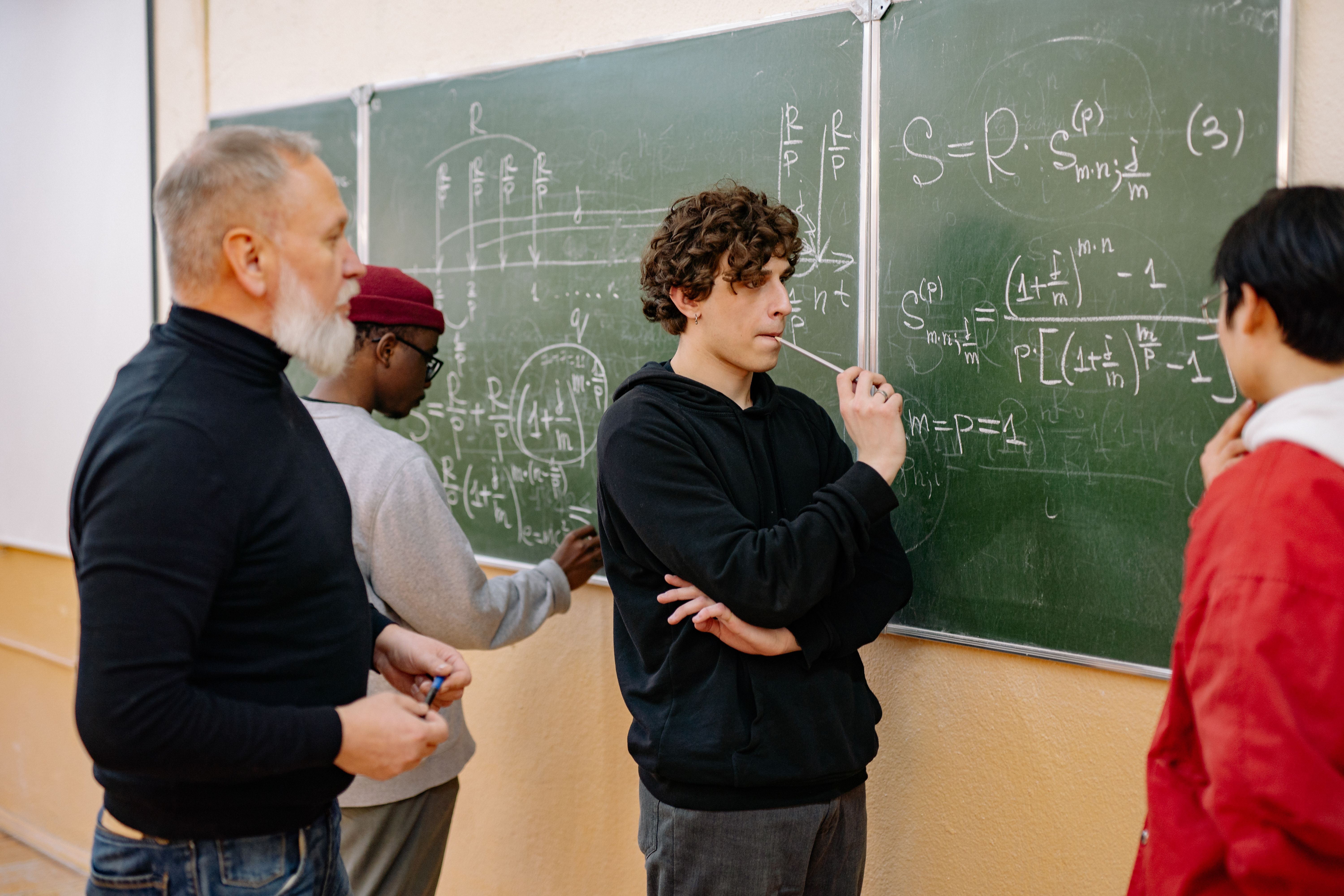
"What do you notice?"
Recently, I was exploring quadratic graphs with a senior student. We were using Desmos to investigate what happened when we changed one coefficient in the equation.
As we varied the value, we recorded the y-coordinate of the vertex.
|
Coefficient |
Vertex y-value |
|
1 |
-1/4 |
|
2 |
-4/4 |
|
3 |
-9/4 |
|
4 |
-16/4 |
|
5 |
-25/4 |
We were just exploring – trying to get a ‘feel’ for how changing the parameters in 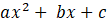 changed the shape of the graph – in analogy to realising that the parameters in a straight-line equation tell you about the slope and y-intercept.
I expected my student to notice that the numerators were the square numbers:
1, 4, 9, 16, 25.
Instead, she surprised me.
She said,
"The differences are getting bigger... they're increasing by 3, then 5, then 7..."
She was absolutely right.
It wasn't the pattern I was expecting her to state, but it was a beautiful observation.
In fact, her observation and mine were describing exactly the same mathematics from two different perspectives.
The square numbers grow by adding consecutive odd numbers:
- 1
- +3 = 4
- +5 = 9
- +7 = 16
- +9 = 25
Neither observation is "more correct" than the other.
One focuses on the numbers themselves.
The other focuses on how the numbers are changing.
Both reveal structure.
This is what real mathematical thinking looks like. It's not about guessing what the teacher wants to hear. It's about looking carefully, making connections and asking, "I wonder why that happens?"
Try this yourself
Look at this sequence.
2, 6, 12, 20, 30
Before trying to find a formula, ask yourself:
What do you notice?
There isn't just one answer.
Perhaps you notice the differences are 4, 6, 8 and 10.
Perhaps you notice the pattern of familiar multiplication facts:
- 1 × 2 = 2
- 2 × 3 = 6
- 3 × 4 = 12
- 4 × 5 = 20
- 5 × 6 = 30
Perhaps you see the pattern:
- 1² + 1 = 2
- 2² + 2 = 6
- 3² + 3 = 12
- 4² + 4 = 20
- 5² + 5 = 30
Or the pattern:
- 2² – 2 = 2
- 3² - 3 = 6
- 4² - 4 = 12
- 5² - 5 = 20
- 6² – 6 = 30
This isn't just coincidence. The patterns are different ways of describing the same sequence, and recognising those connections is an important part of mathematical thinking.
Perhaps you spot something completely different. Spend a minute looking before reading any further.
The important part isn't finding the "right" observation. It's learning to look for patterns at all. That's one of the habits that mathematicians, and successful problem-solvers in every field, develop over time.
At Maths that Clicks, some of the best lessons begin not with an explanation, but with a simple question:
"What do you notice?"